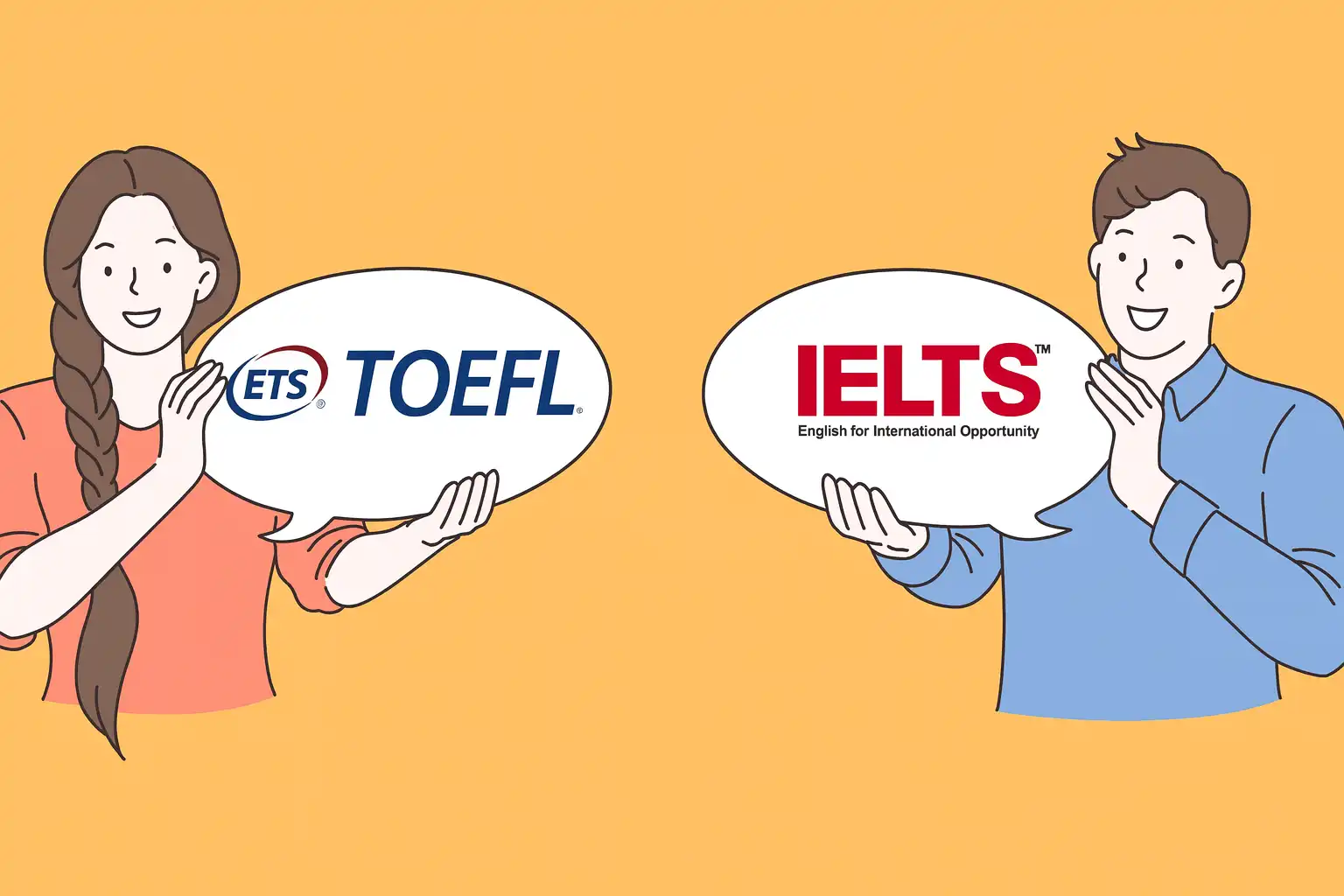
1. Why It’s Important to Choose the Right Exam
IELTS and TOEFL results are accepted by universities, employers, and immigration authorities around the world.
Choosing the right exam helps you avoid unnecessary expenses and stress during preparation.
If you’re applying to a specific university or visa program, it’s best to check in advance which certificate that organization accepts.
Your choice also depends on the test format you’re more comfortable with — working on a computer or on paper, speaking to a real examiner or recording answers.
For many applicants, these details become the deciding factor.
2. What IELTS Is
IELTS (International English Language Testing System) is an international exam administered by Cambridge Assessment, the British Council, and IDP.
It’s used for academic admission, employment, and immigration to English-speaking countries.
Types of IELTS:
- IELTS Academic — for university, college, and academic program admissions.
- IELTS General Training — for professional migration and employment purposes.
IELTS can be taken on paper or on a computer, depending on the test center.
The Speaking section is a live interview with an examiner, where your ability to communicate and present arguments is assessed.
Each section is scored on a 0–9 scale, and the overall band score is the average of all sections.
An IELTS certificate is valid for two years.
3. What TOEFL Is
TOEFL (Test of English as a Foreign Language) is an exam developed by the American organization ETS (Educational Testing Service).
The main version today is TOEFL iBT (Internet-Based Test).
TOEFL is taken entirely on a computer: reading, listening, writing, and speaking are all done online.
In the Speaking section, your answers are recorded via microphone and later evaluated by certified raters — there is no live interview, unlike IELTS.
Each section is scored from 0 to 30, for a maximum total score of 120.
The certificate is valid for two years and is recognized by over 11,000 institutions worldwide.
4. Key Differences Between IELTS and TOEFL
Although both exams serve the same purpose, they differ in structure and style.
- Format: IELTS can be taken on paper or on computer; TOEFL is always online.
- Speaking: IELTS involves a live interview; TOEFL uses recorded responses.
- Task types: IELTS features various formats (gap-fills, short answers), while TOEFL focuses more on multiple-choice and integrated tasks that combine reading and listening.
- Duration: IELTS lasts about 2 hours 45 minutes, while TOEFL takes 3 to 3.5 hours.
- Recognition: IELTS is more common in the UK, Canada, Australia, and New Zealand. TOEFL is traditionally preferred in the USA, but also widely accepted in Europe and Asia.
- Score comparison: According to a 2025 joint study by IELTS and ETS, an IELTS score of 7.0 is roughly equivalent to 94–101 points on TOEFL.
5. How to Decide Which Exam to Choose
Choose IELTS if:
- You plan to study or immigrate to the UK, Canada, Australia, or New Zealand.
- You prefer speaking to an examiner in person.
- You want the option of paper-based or computer-based testing.
- You feel more comfortable with flexible question types and open-ended answers.
Choose TOEFL if:
- You’re applying to a university in the United States or plan a career in an American company.
- You prefer working entirely on a computer.
- You like standardized, objectively scored tasks.
- You would rather avoid a face-to-face interview.
Polyglot recommends choosing your exam thoughtfully — not looking for the “easiest” option, but selecting the format where you can show your strengths.
At our school, you can prepare for IELTS or TOEFL individually: our teachers will help assess your current level, build a strategy, improve all four skills, and reach your target score.
Remember — the right exam choice and high-quality preparation are the first steps toward your international career.